Mirror Lies and Morning Confidence: The Outfit That Peaked at 8 AM

At approximately 8:07 AM, standing in your bedroom in the particular light that comes through your curtains at that exact angle, wearing the new pants you've been saving and the top that finally arrived after two weeks of tracking updates — you looked good. Objectively, demonstrably, undeniably good. You checked from the front. You checked from a three-quarter angle. You may have briefly attempted to see what you looked like from behind using the camera app on your phone, a process that is always humbling but today felt survivable.
You left the house with genuine energy. A little strut. The quiet confidence of someone who had their life together, at least from the waist up.
By noon, you were hiding in the bathroom at work, staring into a different mirror in a different light, wondering who dressed you and why they hated you.
Welcome to the Bathroom Mirror Audition — the performance your clothes give without you, in lighting conditions you did not approve, in front of audiences you did not cast.
The Problem With Your Bedroom Mirror (It Loves You Too Much)
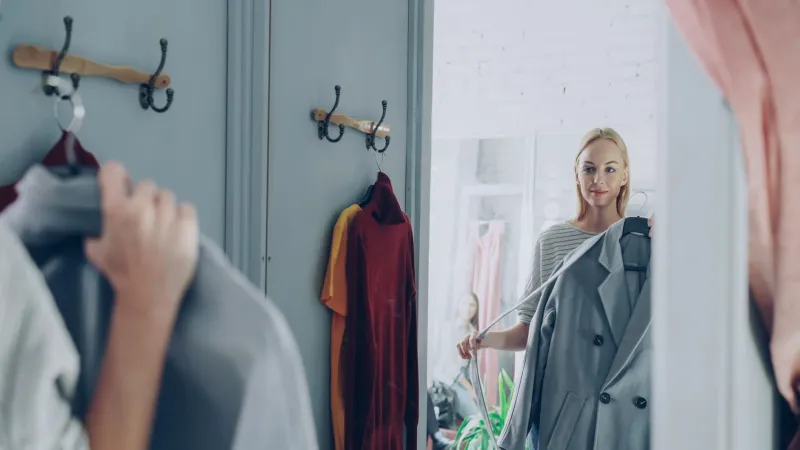
Your bedroom mirror is, essentially, your most supportive friend. It's positioned exactly where you positioned it, which means it's tilted at the angle most flattering to your height. The light in your room is warm, or at least familiar — you've curated it, consciously or not, over years of living in that space. Your brain, seeing your own reflection in a context you associate with safety and routine, fills in gaps generously.
This is not a character flaw. It's neuroscience. Our brains are wired to complete incomplete pictures favorably when we're in low-threat environments. Your bedroom is, presumably, a low-threat environment. The office bathroom with the overhead fluorescent lighting that makes everyone look like they're being processed for a county ID? Extremely high-threat environment.
Different mirrors, different lighting, different cognitive states — the outfit didn't change. The context did. But the outfit gets the blame every time.
The Daylight Problem
Indoor lighting, particularly the warm-toned variety most people have in their homes, is doing significant work on your behalf that natural light absolutely refuses to do. Colors that look rich and intentional under incandescent light become chalky and strange in direct sun. Fabrics that drape beautifully in still air catch wind in ways that the bedroom mirror could not have predicted. Whites that looked crisp at 8 AM achieve a kind of translucence by 11 that raises questions.
There's also the movement problem. Your bedroom mirror shows you a still image of yourself. Real life involves walking, sitting, standing from seated positions, reaching for things on high shelves, squeezing past people in crowded coffee shops, and a dozen other physical events that your outfit was not technically auditioned for.
The pants that looked perfectly tailored while you were standing at attention in your bedroom may have very different opinions about what happens when you sit down for four hours. The top that was laying perfectly flat in the mirror has thoughts about what occurs when you carry a tote bag on one shoulder for six blocks. These are not conversations you can have in advance. They happen in real time, in public, with no opportunity for wardrobe changes.
The Noon Shift: When the Outfit Becomes a Costume
There is a specific psychological moment — usually somewhere between 11:30 AM and 1 PM — when an outfit transitions from feeling like an expression of self to feeling like a disguise. Fashion psychologists (yes, this is a real specialty, and they are doing important work) describe this as a kind of confidence fatigue: the initial boost of wearing something new or intentional wears off as the day progresses and the outfit stops feeling like a choice and starts feeling like a commitment you can't back out of.
You can't go home and change. You made your decision at 8 AM and you are legally bound to it until at least 6 PM. The sequined detail that felt playful and fun in the morning now feels like you're asking for a conversation you don't have the energy for. The bold color that felt like a statement now feels like a liability. The shoes that seemed worth the slight discomfort at 7:45 AM are now filing a formal complaint.
This is the Noon Shift. It happens to almost everyone, almost every day, and the fashion industry has absolutely no incentive to acknowledge it.
The Photography Conspiracy
A secondary dimension of the Bathroom Mirror Audition is the photograph problem. The modern fashion purchase cycle involves a significant amount of imagining how you'll look in photos — because we live in an era where the photo is sometimes the whole point. You buy the dress. You imagine the photo. The photo is the justification.
Bedroom mirror light, as previously established, is flattering. Phone cameras, when pointed at yourself in the bathroom mirror, are less so. Natural daylight photographs are a third thing entirely. And candid photos taken by strangers at events — the ones that show up tagged on Instagram three days later — are operating in a completely different reality from the one you constructed in your head while standing in your bedroom at 8 AM.
The outfit that photographed beautifully in your carefully lit selfie looks boxy and formless in the candid someone took while you were laughing at a party. The color that popped in your mirror looks washed out in outdoor event photos. None of this is the outfit's fault, technically. But you bought the outfit based on the mirror version, and you live in the candid version, and nobody is reconciling these two realities for you.
What This Reveals About How We Actually Shop
The gap between the 8 AM mirror version and the noon reality version of any given outfit exposes something worth sitting with: most of us buy clothes for an imagined life that involves better lighting, more controlled environments, and a more static existence than we actually have.
We try things on in fitting rooms — also controlled environments with their own specific lighting agendas — or we order online and try things on in our bedrooms. We make decisions based on a snapshot of ourselves in the best possible conditions. Then we wear the clothes in actual conditions, which are unpredictable, physically demanding, and lit by whatever God and the building's facilities manager decided on.
The purchase is optimistic. The wearing is realistic. The gap between them is where most of our wardrobe regrets live.
A Modest Proposal
The only real solution — and fashion brands will never, ever suggest this — is to audition your outfits in conditions that approximate reality. Go outside in it. Sit in it for twenty minutes. Walk more than the distance from your bedroom to your front door. Take a photo in actual daylight before you commit.
This process is inconvenient, time-consuming, and requires getting dressed earlier than any of us want to. It will also save you from a truly remarkable number of noon-hour bathroom crises.
Alternatively, you can keep doing what you're doing: trusting the 8 AM mirror, leaving the house with misplaced confidence, and having a deeply personal reckoning with your reflection somewhere around lunchtime.
Both are valid approaches. One of them is more honest.