The Emotional Surcharge: How Brands Figured Out You'll Pay More to Feel Better
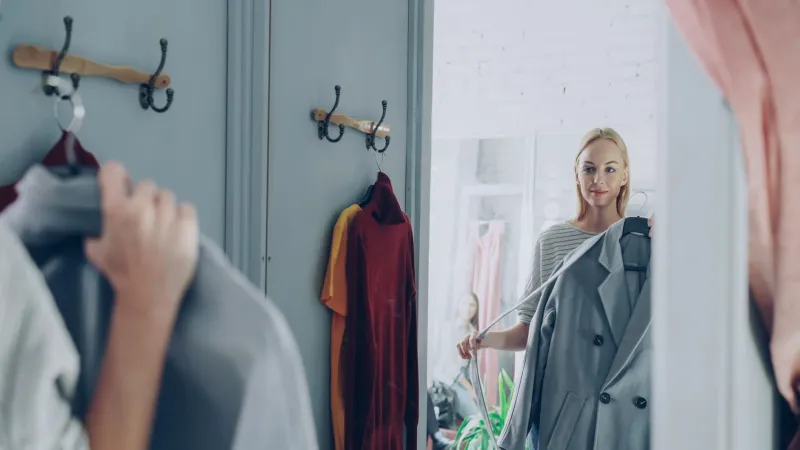
Let's do a quick thought experiment. Two blazers. Same polyester-blend construction. Same slightly-too-stiff shoulders. Same vague Italian-sounding name on the label that was definitely manufactured in the same facility in Vietnam. One is marketed as a "relaxed workday layer." The other is marketed as "armor for the boardroom." Guess which one costs $340 more?
If you guessed the armor, congratulations. You understand the fashion industry better than you probably wanted to.
This is the Confidence Tax — an unofficial surcharge applied to any garment that promises to fix something emotional rather than something practical. It's not a conspiracy. It's not even subtle. It's just capitalism doing what capitalism does best: finding the exact nerve ending that hurts and charging you a premium to soothe it.
The Price of Feeling Like Yourself (Apparently, Around $485)
The mechanics of confidence pricing are almost elegant in their simplicity. Standard retail markup runs somewhere between 50 and 60 percent over production cost. Emotional markup? That's a different animal entirely.
When a brand positions a garment around identity — around the person you could be while wearing it — the price ceiling basically disappears. You're no longer buying a pair of trousers. You're buying the version of yourself that finally has their act together. That version of yourself, it turns out, retails for considerably more than the version currently standing in the dressing room under fluorescent lighting, questioning every choice they've ever made.
Research in consumer psychology has documented this phenomenon for decades. People consistently assign higher value to products they believe will improve their social performance or self-perception. Fashion brands didn't invent this. They just industrialized it with better photography and a really good Instagram presence.
Same Silhouette, Different Story, Wildly Different Price
Here's where it gets genuinely interesting. Pull up any fast-fashion retailer right now and search for a straight-leg trouser in a neutral color. You'll find something for $34.99 described as "relaxed fit pants" with a product description so uninspired it might as well say "pants. they're pants."
Now pull up a brand that uses words like "intentional," "considered," or — God help us — "elevated basics." Find their straight-leg trouser in a neutral color. Same silhouette. Potentially the same factory. The description will mention how the cut was "designed to move with you" and how the fabric was "thoughtfully sourced." Price: $178.
The difference isn't construction. It's narrative. One pair of pants is just pants. The other pair of pants has a story — and you're paying for the story almost as much as the garment.
This is not an accident. It is a strategy, and it works spectacularly well because we are all, at some level, in the market for a better story about ourselves.
The Empowerment Aisle Is the Most Expensive Aisle
Fashion's relationship with the word "empowering" deserves its own congressional hearing. Somewhere in the last decade, "empowering" became the single most profitable adjective in retail. A dress described as "empowering" costs more than the same dress described as "fun." A sneaker that "empowers your stride" costs more than a sneaker that "provides cushioning."
This is not speculation. A quick survey of marketing language across mid-to-high-end fashion brands reveals a reliable pattern: the more emotional the promise, the higher the price point. Brands selling confidence, power, ease, authenticity, or transformation consistently price 30 to 60 percent above brands selling equivalent products with functional descriptors.
The genius — and it is a kind of genius, even if it's a maddening one — is that the emotional promise is unverifiable. If a shoe claims superior arch support and delivers inferior arch support, you can return it. If a blazer claims to make you feel "unstoppable" and you still feel very stoppable on Tuesday morning, that's apparently a you problem.
Why We Keep Paying It
The honest answer is that it sometimes works. Not because the clothes are better. But because the belief that the clothes are better creates a real psychological effect. Researchers call it enclothed cognition — the documented phenomenon where what you wear influences how you think and perform. Put someone in a lab coat and their attention to detail improves. Put someone in clothes they associate with competence and they perform more competently.
Fashion brands didn't read those studies and then exploit them. They figured out the same thing empirically, over decades, by watching what people spent money on when they were scared, hopeful, or at a crossroads. Job interview coming up? Promotion within reach? First date after a hard breakup? The confidence-coded item moves. Every time.
So we keep paying the Confidence Tax because occasionally — occasionally — the receipt comes with a side of genuine psychological benefit. The blazer doesn't get you the job. But the feeling of wearing the blazer you believe in might get you to show up differently. And sometimes showing up differently is the whole game.
The Part Nobody Wants to Say Out Loud
Here's the uncomfortable conclusion: the Confidence Tax is partially a scam and partially not a scam, which makes it almost impossible to be righteously angry about.
You can't fully dismiss the emotional value of clothing. You also can't pretend that a $340 markup is justified by vibes alone. The truth lives somewhere in the middle, in that deeply inconvenient space where psychology and commerce overlap, where you're never quite sure if you're making a rational purchase or an emotional one dressed up in rational clothing.
What you can do is notice the language. Notice when a product description is selling you a feeling rather than a feature. Notice when the price jumps and the fabric doesn't. Notice when "empowering" shows up in a headline and your credit card hand starts twitching.
Noticing won't stop you from buying it. But at least you'll know exactly what you're paying for.
The blazer, and the story. Mostly the story.