Four Dollars and Zero Judgment: A Complete Psychological Breakdown of Thrift Store Self-Deception
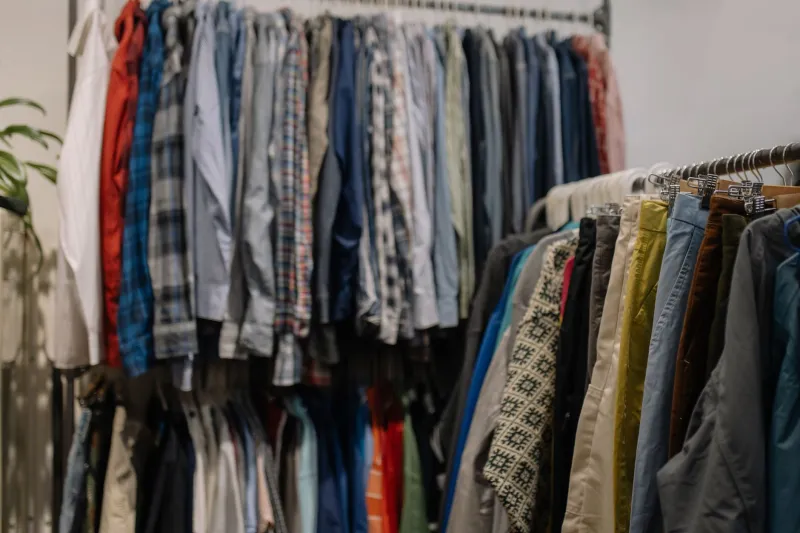
Something happens to the human brain the moment it crosses the threshold of a Goodwill, a Savers, or a particularly chaotic local thrift shop that smells faintly of cedar and regret. Rational thought — the kind that usually prevents you from spending $400 on a jacket you'll wear once — simply evaporates. In its place arrives a warm, intoxicating conviction that the sequined vest currently dangling from your fingertips is, in fact, a statement piece. A find. An investment in your personal mythology.
The price tag says $4.99. Your brain says: unlimited potential.
Welcome to thrift store delusion. Population: all of us.
The Irony Loophole: Fashion's Most Abused Legal Clause
Let's begin with the most powerful phrase in the modern thrift store vocabulary: I'll wear it ironically.
This sentence has single-handedly justified more questionable purchases than any other combination of words in the English language. It is the magic spell that transforms a sequined cowboy vest, a neon windbreaker with a regional bowling league logo, or a blazer with aggressively padded shoulders into something that belongs in your life.
"Ironically" implies intent. It implies control. It implies that you, a sophisticated person with taste, are choosing to engage with this garment on your own terms, from a position of cultural awareness and light self-deprecation.
What it actually means: you will wear it once, to a party where you feel brave, receive two polite compliments and one genuinely confused look, and then hang it in the back of your closet where it will live, still tagged, for the next four years.
The irony, ultimately, is that the irony never arrives.
A Field Guide to Classic Thrift Store Self-Deceptions, Ranked by Shelf Time
Not all thrift store delusions are created equal. Some items cycle in and out of the donation pile with admirable speed. Others achieve a kind of immortality, moving from closet shelf to donation bag and back so many times they practically have their own frequent flyer miles.
Tier One: The Quick Flip (Donated Within Six Months)
These are the purchases that even your most optimistic inner voice can't sustain. The novelty holiday sweater bought in July. The formal gown you were certain you'd alter. The fur-trimmed coat that looked amazing on the rack and immediately made you look like you were auditioning for a community theater production of a Chekhov play.
You tried. You failed. You let go. Respect.
Tier Two: The Eternal Maybe (Lives in Closet for One to Three Years)
This is the sweet spot of thrift store delusion. The item is weird enough that you can't comfortably wear it but interesting enough that you can't bring yourself to give it up. The hand-painted denim jacket. The floor-length floral skirt that technically fits. The blazer with the embroidered parrots that you keep telling yourself is "very Gucci-adjacent."
Every six months or so, you pull it out, hold it up, and think: this summer. Then you put it back.
Tier Three: The Founding Member (Has Been in Your Closet Longer Than Some Friendships)
This item has transcended the question of whether you'll ever wear it. It simply exists now, as a permanent fixture of your wardrobe ecosystem. You don't even see it anymore. It's just part of the closet's architecture. A $3 velvet blazer in a color that doesn't technically exist in nature. A pair of embroidered cowboy boots two sizes too small that you bought because you were sure you could stretch them out.
You cannot stretch them out. You know this. The boots know this. And yet.
The Low Price Paradox: When Cheap Costs You Everything
Here is the cruel mathematical irony at the heart of thrift store psychology: the lower the price, the worse your decision-making becomes.
Spend $150 on a blouse at a department store and you will try it on, scrutinize it under three different lighting conditions, consult your phone camera, and probably still go home and think about it. Spend $6 on that same blouse's unhinged cousin — the one with the statement sleeves and the abstract print — and you will be at the register before you've even finished processing what you're holding.
This is known, in behavioral economics, as the low-cost commitment trap. In fashion psychology, we just call it Goodwill brain.
At $6, the stakes feel so low that normal risk assessment simply doesn't apply. What's the worst that could happen? You waste $6. Except you don't waste $6. You waste $6, plus two square feet of closet space, plus the next three years of quietly moving this item from one shelf to another.
The Justification Architecture of a Thrift Store Purchase
No thrift store acquisition arrives without its own elaborate internal monologue. Here, for your recognition and mild horror, is a standard example:
Step 1: Discovery. You find the item. Your heart does a small, inexplicable thing.
Step 2: The Pitch. You begin constructing the outfit around it in your head. You don't own the other pieces, but that's fine. You'll get them.
Step 3: The Justification. "It's $4. Even if I never wear it, it's $4. I spend more than that on a latte."
Step 4: The Escalation. "Actually, this is sustainable fashion. I'm helping the environment."
Step 5: The Vision. You are wearing this at a rooftop party. It's golden hour. Someone asks where you got it. You say, casually, oh, this? Thrifted it. You are effortlessly cool.
Step 6: The Purchase. Done. It's yours.
Step 7: The Reality. It lives on the shelf. The rooftop party happened. You wore jeans.
In Defense of the Delusion
Here's the thing, though — and we say this with complete sincerity beneath the gentle mockery — there is something genuinely wonderful about the thrift store mindset. It is one of the last places where fashion feels truly low-stakes, genuinely playful, and completely divorced from the relentless pressure to buy the right thing at the right moment for the right occasion.
The sequined vest might never leave the closet. The bowling league windbreaker might only exist in your life as a source of private amusement. But the $4 you spent on the fantasy? On the brief, vivid moment of imagining who you might be if you were the kind of person who wore a sequined vest?
That's practically free therapy.
Just maybe stop telling yourself you'll wear it ironically. You won't. And somewhere, in a Goodwill three towns over, another sequined vest is already waiting for you to try again.