Forgive Me, Zara, For I Have Browsed: A Confessional for Everyone Who Walked In for One Shirt and Left as a Different Person
It started innocently. It always starts innocently. We needed one thing — a plain white tee, maybe a pair of black trousers for that Thursday meeting, possibly just a look around to 'get inspired.' We were not going to buy anything. We said this out loud, to ourselves, in the parking lot, like a person of sound mind and reasonable financial habits.
Then the doors slid open.
And something happened to us in there. Something that cannot be fully explained by conventional science, but can absolutely be explained by retail psychology, strategic lighting design, and a playlist that makes you feel like you're the main character in a European coming-of-age film.
This is our confession. And if you've ever walked out of a fast-fashion store with a bag full of items that collectively constitute a brand-new identity, pull up a chair. We see you. We are you.
The Eight-Minute Window
Here is what the stores know that we refuse to accept: the moment you cross the threshold, you have approximately eight minutes before 'just browsing' becomes 'actively auditioning a new life.'
It's not weakness. It's architecture.
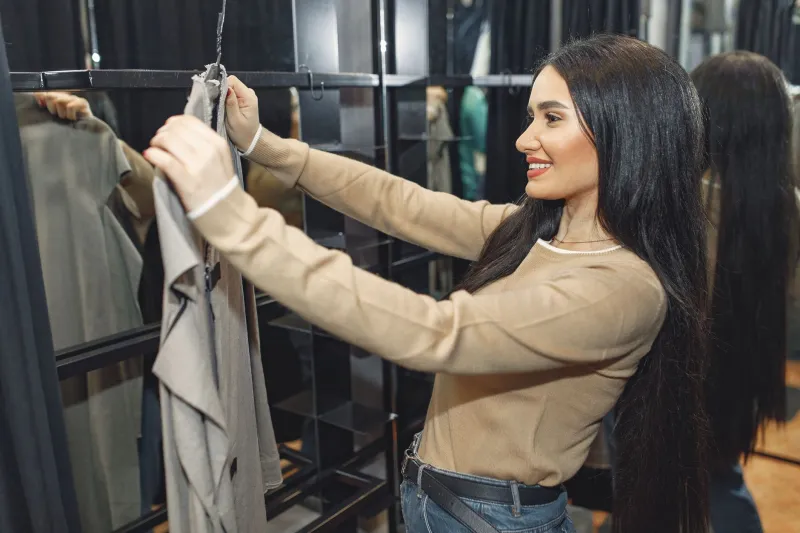
The floor plan of your average Zara, H&M, or Mango is not designed for efficiency. It is designed for wandering. Wide, open pathways that funnel you past things you didn't come for. Mannequins styled in complete, aspirational outfits — not just selling a jacket, but selling the version of you who wears that jacket to a rooftop event in Barcelona. Racks arranged not by category but by vibe, so that a sage-green blazer is somehow adjacent to a pair of wide-leg trousers and a crinkled blouse, and your brain does the math before your wallet can object.
By minute four, you're holding something. By minute eight, you're in a dressing room.
Game over.
The Lighting Is Lying to You (and You're Grateful)
Let's talk about dressing room lighting, because it deserves its own TED Talk and possibly a congressional hearing.
The lighting in those fitting rooms is doing something deeply unfair. It is warm. It is flattering. It hits at an angle that makes your collarbones look like a Renaissance sculpture. You put on a $49 satin slip dress that, outside of this specific electromagnetic environment, would look like a pillowcase with ambitions — and in here, you look incredible.
You take a photo. You send it to the group chat. Three people send the fire emoji.
The dress is now coming home with you.
What you will discover approximately 72 hours later, under the cold fluorescent tyranny of your bathroom mirror, is that the dress looks different. Not bad, necessarily, just... different. Like a photograph of a meal that doesn't quite match the menu picture. The dressing room was lying. You knew it was lying. You let it lie because the lie was so beautiful and the music was so good.
The Playlist Is Doing Something to Our Brains
Speak of which — the music.
Somewhere in a corporate office, there is a person whose entire job is to curate the in-store playlist for a fast-fashion retailer, and that person is either a genius or a villain, possibly both. The songs are not quite familiar enough to be distracting but just cool enough to make you feel like you're already the version of yourself who owns this entire rack.
It's a low-key, mid-tempo, vaguely international sound that says: you are effortless. You are European. You are the kind of woman who buys interesting earrings on a Tuesday.
And so we buy the interesting earrings on a Tuesday.
The Spiral, Itemized
For transparency, and in the spirit of true confession, here is a rough timeline of how a 'quick browse' typically escalates:
0:00 — Enter store. Looking for one black top. Will not spend more than $30.
0:04 — Notice a display of what appears to be an entirely new collection. Pick up a textured blazer 'just to feel it.'
0:09 — The blazer is actually very soft. Drape it over your arm 'just to see.'
0:14 — Spot trousers that would go with the blazer. Pick those up too. Just for reference.
0:22 — You're in the dressing room. You brought seven items. You came for one.
0:38 — Exiting the dressing room with three confirmed purchases and a deeply conflicted relationship with a fourth.
0:41 — The fourth item is now in the basket. It would be wasteful not to.
0:47 — At the register. The total is $127. You do not remember how this happened.
0:49 — Back in the parking lot with a large paper bag and a new perspective on who you are as a person.
The Identity Acquisition Problem
Here's the real confession, the one buried under all the jokes about lighting and playlists: we don't just walk out of these stores with clothes. We walk out with a temporary sense of possibility.
The $34 linen blazer isn't just a blazer. It's a version of us that has it together. That goes to farmers markets and reads physical books and has a skincare routine with more than two steps. The wide-leg trousers are for the person we're becoming. The ceramic candle from the homeware section — which, by the way, we should never be allowed to enter — is for the apartment that matches our vision board.
Fast fashion doesn't just sell clothes. It sells the fantasy that a wardrobe refresh and a personality upgrade are the same transaction.
And look, we know. We know. The blazer is not going to reorganize our lives. The trousers are not going to make us more interesting. The candle is going to sit on a shelf for six months before we remember we own it.
But for the forty-five minutes we were in that store, standing under the warm light with the cool music playing, we really believed it might.
And honestly? That's worth something.
Probably not $127 something. But something.
Check your bank statement. Say three Hail Marys. See you at Zara next weekend.