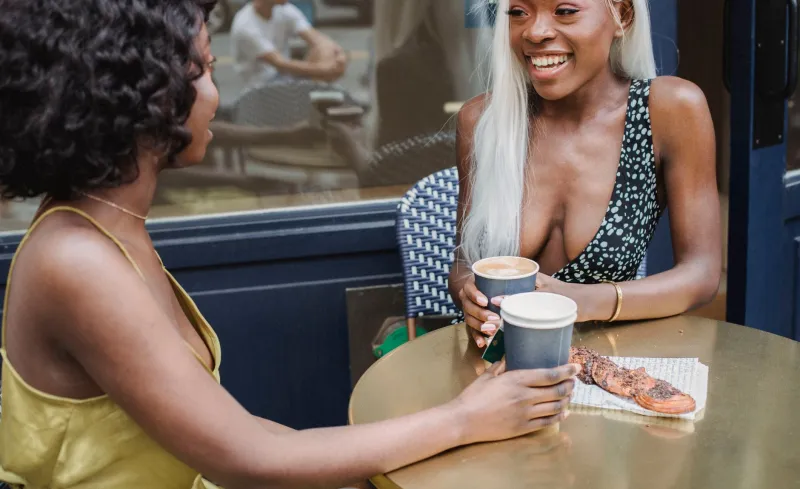
The Content Closet: Inside the Secret Wardrobe Americans Built Exclusively for the Internet

Let's talk about the dress.
You know the one. You bought it in March. It arrived, you tried it on, you thought okay, yes, this is the one — and then you hung it up. Not because it didn't fit. Not because you changed your mind. But because you were waiting for the right light. The right location. The right caption energy. The right Saturday afternoon where you could get your roommate to take thirty-seven photos of you walking toward a wall you specifically selected for its texture.
The dress has been worn, technically, for approximately forty-five minutes across two separate "shoot days." It has appeared on your grid twice. It has not been worn to an actual place where actual humans exist in real time.
This is not unusual. This is, increasingly, just how it works.
The Grid Versus the Life
There is your life — the one where you eat cereal over the sink, wear the same three hoodies on rotation, and get dressed in the dark on weekday mornings because the idea of making a real decision before 8am is genuinely threatening.
And then there is your grid. The grid is curated. The grid has a color palette. The grid version of you has apparently been to a lot of charming outdoor locations and owns an impressive number of linen pieces.
The gap between these two realities is not new. People have been presenting aspirational versions of themselves since long before smartphones existed. What is new is that the gap now has its own dedicated wardrobe budget.
Americans are buying clothes specifically, deliberately, and with full premeditation — not to wear them, but to photograph them. And somehow, remarkably, this feels completely reasonable in the moment.
The Economics of Looking Like You Live There
Here is the mental accounting that makes the content closet financially defensible in the mind of the person building it:
A "content outfit" that performs well — meaning it gets saved, shared, and generates the specific dopamine hit of strangers validating your aesthetic — has an ROI that a regular outfit simply cannot match. Your Wednesday jeans don't get 847 likes. Your Wednesday jeans don't drive traffic. Your Wednesday jeans are just jeans, quietly doing their job with no appreciation whatsoever.
But the $120 wrap dress you bought specifically because it photographs well in natural light? That's an asset. That's content. That's practically a business expense.
(It is not a business expense. Please do not tell your accountant we said this.)
A Taxonomy of Content Outfit Behaviors
For the uninitiated, here is a brief field guide to the content closet ecosystem:
The Hero Piece — Purchased entirely because it will anchor a grid post. Usually involves a color that pops. Has never been worn to a grocery store.
The Transitional Statement — Bought to signal a new "era" of your aesthetic. Used in exactly one Reel. Currently in wardrobe purgatory while you figure out what the next era is.
The Background Outfit — Technically the supporting character, but secretly the most-worn item because it goes with everything and requires no planning. Not glamorous. Deeply reliable. The content closet's unsung hero.
The Caption Bait — An item purchased specifically because it will generate comments. A vintage band tee. An ironic tote. A hat with exactly the right amount of personality. It is doing a job, and it is doing it well.
The One-And-Done — Worn once, photographed extensively, returned within the 30-day window. We are not here to judge. We are here to acknowledge that the return shipping label was printed before the photos were even edited.
The Outfit-to-Caption Ratio
Here is a metric the fashion industry does not officially track but absolutely should: the amount of time spent planning, purchasing, and styling an outfit versus the amount of time the outfit is actually on your body in the real world.
For a standard content outfit, this ratio is roughly 4:1. Four hours of consideration — browsing, ordering, waiting, trying on, photographing, editing, captioning, posting — for every one hour of actual wear. Some pieces push this ratio to 12:1. Some legendary content pieces have been photographed more times than they've been worn in a non-performance context.
And yet the caption always says "just threw this on." The caption always implies effortlessness. The caption is, without exception, a work of fiction.
Why the Grid Always Looks Better Than Your Actual Tuesday
The grid has good light, a considered background, and forty-five minutes of preparation behind every "candid" shot. Your actual Tuesday has overhead fluorescent lighting, a lunch you ate at your desk, and an outfit selected entirely based on what was clean.
The grid is not your life. It is a highlight reel of a parallel life where you have better posture and consistently interesting things to lean against.
This is not a criticism. This is just the deal we've all implicitly agreed to. Social media is a performance, the content closet is the costume department, and the grid is the stage. As long as everyone understands the terms, it's fine.
The part that gets complicated is when the performance starts driving purchasing decisions for the real life. When you find yourself standing in a dressing room thinking not will I wear this but will this perform — that's when the content closet has officially taken over.
The Hanger Report
A brief, unsolicited audit of the content closet's permanent residents:
- One structured blazer in a color described as "clay" — worn twice on camera, zero times otherwise
- A pair of wide-leg trousers that require the correct shoes, which have not yet been purchased
- Three silk-adjacent blouses from a brand that showed up in your algorithm for two weeks straight
- One dress that is technically perfect but requires a specific undergarment situation that has not been resolved
- A hat. Just a hat. It looked incredible in the photo.
All of them are waiting. All of them are ready. The grid will call when it needs them.
A Love Letter to the Real Wardrobe
Somewhere in your closet, behind the content pieces and the aspirational purchases and the items still in their original packaging, are the clothes you actually wear. The ones that are slightly faded and definitely pilling and have a pocket you've used so many times the seam is going. The ones that have been to real places with you — airports, bad dates, good concerts, Tuesday mornings.
Those clothes don't photograph particularly well. They don't have a caption. They don't perform.
But they are, quietly and without any acknowledgment, doing the actual work.
Maybe give them a moment.